
My mother, (age 66), my self (42,) and my daughter (18) all went snorkeling together we had an awesome time. The guides were funny and had a lot of information. They...
In September 13, 2024Sea anemones are fascinating organisms that, although they may look like underwater flowers at first glance, belong to a very different group from the plant world. In fact, anemones are more closely related to corals and jellyfish, and they play an important role in marine ecosystems. In this article, we will explore what anemones actually are, how many species are known worldwide, what makes them special, and we will dedicate a section to the anemones that can be found around Cancún (Mexico), to better understand the local biodiversity and its conservation.
Sea anemones belong to the order Actiniaria within the class Anthozoa (which includes corals and anemones). They are marine invertebrate animals of the phylum Cnidaria. They are often compared to flowers because of their “stem plus tentacles” shape, which resembles flower petals—hence their common name “anemone” (after the flower)—though they are not related to plants at all.
– The body of a typical anemone consists of an adhesive base called the pedal disc, which allows it to attach to a hard surface (rock, coral, submerged wood, etc.).
– From this base rises a column or cylinder topped by an oral disc that surrounds the animal’s mouth. Around the oral disc are arranged the tentacles, which can extend or retract.
– The tentacles are equipped with stinging cells called cnidocytes (or nematocysts) that help capture prey, paralyze it, and bring it to the mouth.
– Although they may appear permanently fixed, some species move very slowly or occasionally change location.
– They lack a rigid skeleton (no bones or shell), though they can secrete structures or adhere firmly to the substrate.
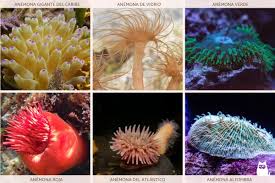
Anemones live in a wide variety of marine environments: shallow waters, coral reefs, sandy bottoms, seagrass meadows, mangroves, and even deep-sea areas. Many species prefer warm tropical regions, where diversity is highest. They are carnivorous or detritivorous animals that feed on small crustaceans, fish, plankton, or organic matter that drifts near their tentacles.
Anemones can reproduce both sexually and asexually. In sexual reproduction, they release eggs or sperm into the water or fertilize internally. In asexual reproduction, some species can split longitudinally or fragment their pedal disc to produce new individuals.
One of the best-known relationships is that between certain anemones and clownfish (for example, of the genus Amphiprion). The fish take refuge among the anemone’s tentacles, protected from predators, while the anemone benefits from leftover food. Anemones also form symbiotic relationships with algae, shrimp, hermit crabs, and other organisms.
Overall, anemones are key components of marine ecosystems — they serve as shelter, part of the biological substrate, nutrient capturers, and integral elements of marine biodiversity.
According to available information:
• The Encyclopaedia of Life indicates that the order Actiniaria includes around 1,235 species, distributed across 278 genera and approximately 50 families.
• Other general sources mention “over 1,000 species” of sea anemones worldwide.
Thus, although the exact number varies (since new species are continually discovered), we can safely state that at least a thousand species of sea anemones exist globally.

Within the order Actiniaria, several families are recognized. Some representative groups include:
• Family Actiniidae: one of the largest families, which includes many common anemones.

• Family Stichodactylidae: large species that often form symbioses with clownfish.

• Family Aiptasiidae: anemones that commonly colonize hard substrates and are well known in aquariums.

• Family Actinodendridae: rarer species, some with more potent venomous tentacles.
The greatest diversity of anemones is found in tropical coastal waters; however, there are also species in temperate seas and at great ocean depths.
The variation in size (from just a few millimeters to more than half a meter in diameter), coloration, tentacle shape, attachment methods, and reproductive strategies makes anemones a highly diverse group with broad ecological adaptations. This diversity makes them important indicators of marine ecosystem health and valuable subjects for studies in biology, ecology, and conservation.
The coastline of Quintana Roo, home to well-known destinations such as Cancún and the Riviera Maya, lies within the Mexican Caribbean and hosts a rich marine biodiversity. Although anemones are often less conspicuous than corals or fish, they are part of the region’s benthic fauna.
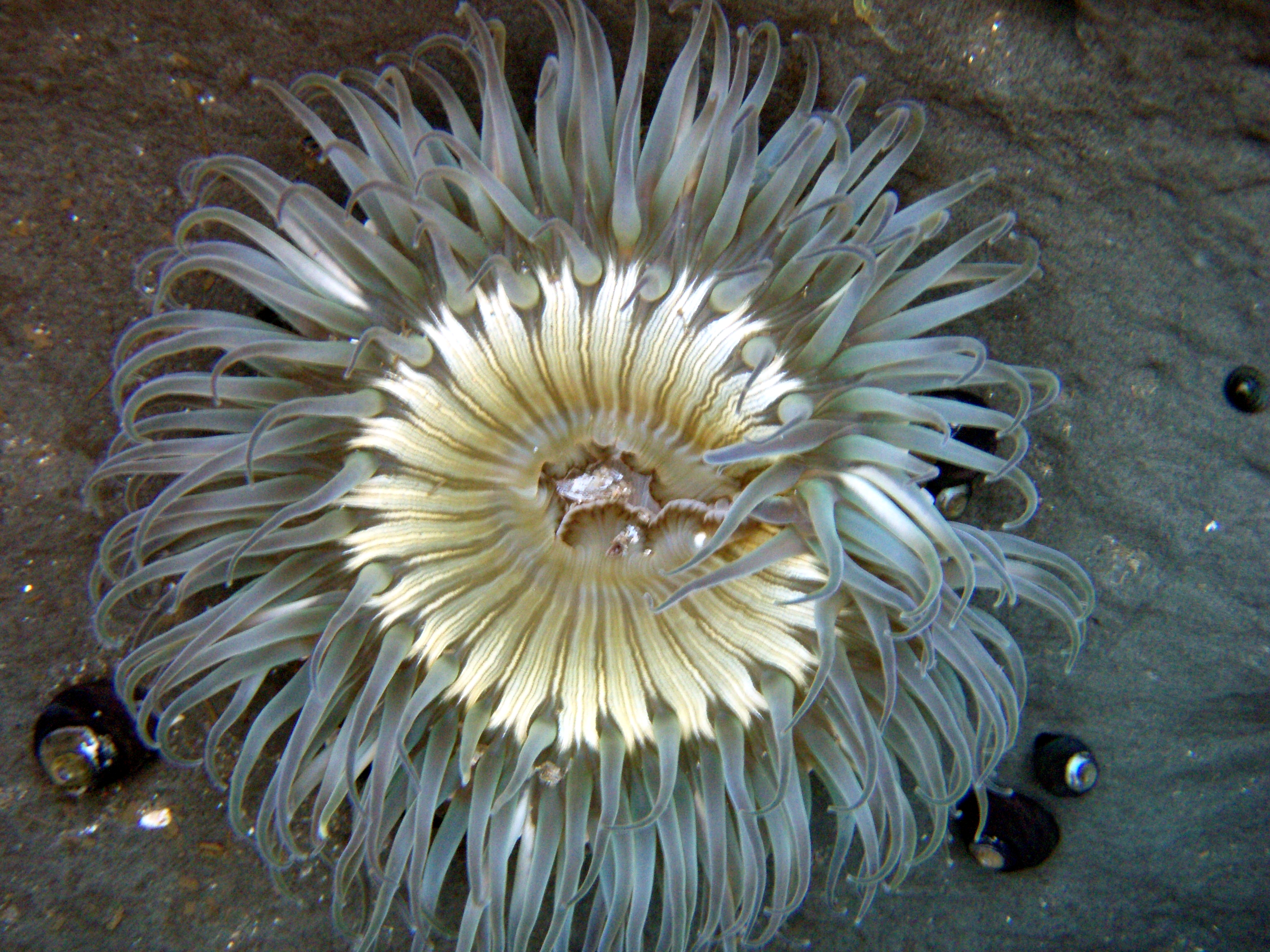
• A study titled “First Inventory of Sea Anemones (Cnidaria: Actiniaria) of the Mexican Caribbean” documented 10 species of anemones in 11 reef localities in the Mexican Caribbean (2006–2011).
• Another study focused on the coast of Yucatán (a nearby region) reported 8 species of anemones in five coastal sites.
These studies show that the region hosts at least several documented species of anemones, though the actual diversity may be higher (as many records remain incomplete).
From the Yucatán study, the following species were mentioned:
• Actinostella flosculifera
• Bunodosoma granuliferum
• Anemonia sargassensis
• Exaiptasia diaphana
• Calliactis tricolor
These species are among the most common or best documented in these studies.
Anemones in Cancún are found on coral reefs, rocky zones, among dead coral or rubble, in seagrass meadows, mangroves, and sometimes in sandy areas near reefs.
For example, the Yucatán coast study indicated that specimens were collected from very shallow depths (0–2 m), suggesting that many species are accessible to snorkelers.
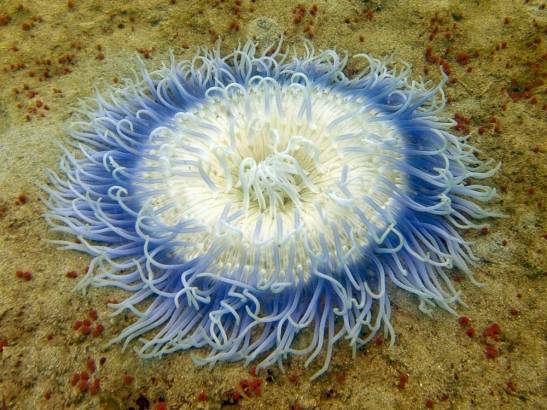
In the Mexican Caribbean, anemones contribute to the ecological complexity of reefs and coastal zones. They serve as shelter or habitat for other organisms (for example, cleaning shrimp such as Periclimenes yucatanicus, which lives among the anemone’s tentacles).
Moreover, the presence of healthy anemones can indicate good substrate and water conditions — adequate lighting, water quality, and undamaged habitats.

The Mexican Caribbean coast faces several threats that also affect anemones and other benthic organisms, such as:
• Massive sargassum arrivals that can cause low oxygen conditions and organism die-offs in shallow areas.
• Climate change, ocean acidification, rising sea temperatures, and coral bleaching, which can alter the benthic communities where anemones live.
• Unregulated tourism, boat anchoring on reefs, and careless snorkeling or diving, which can damage the substrates anemones attach to.
• Sedimentation and pollution that can cover hard substrates or reduce water quality.
Thus, documenting and studying local anemones contributes to broader efforts to conserve coral reef and coastal ecosystems in the Cancún–Riviera Maya region.
If you visit Cancún and go snorkeling or diving (even nearshore in shallow reef areas), consider these tips:
• Look closely at hard surfaces like rocks, dead coral, or rubble where brightly colored anemones (orange, green, red, or pink) may be attached.
• Observe the anemones’ tentacles carefully: they may be extended to capture food or retracted if there is strong wave motion or nearby activity.
• Do not touch the tentacles: although most species are harmless to swimmers, contact can harm them or alter their behavior.
• Support responsible tourism initiatives: avoid stepping on reefs, do not touch marine life, and avoid sunscreens containing reef-harmful chemicals.
• If you have a snorkeling or diving guide, ask about benthic fauna—many instructors know the local species and can point out interesting anemones.

Sea anemones are remarkable organisms: simple in appearance, yet complex in their biology, ecology, and evolution. With over a thousand known species worldwide, they inhabit a wide range of marine habitats and display great diversity in form, size, and lifestyle. In the Riviera Maya and Cancún region, these creatures are part of the rich marine biodiversity, even if they often go unnoticed compared to more striking corals and fish.
However, their presence and health are indicators of the well-being of coastal ecosystems. Learning about them, respecting them, and preserving their habitats is part of our commitment to the Mexican Caribbean Sea. Next time you snorkel in Cancún, take a moment to look closely at that “flower-like” form beneath the water—it might just be an anemone, alive, steadfast, and waiting for you to notice it.
Ready for an unforgettable adventure? Join us and discover the magic of these amazing marine creatures!
Facebook: Facebook
Instagram: Cancun Snorkeling (@cancunsnorkeling_) • Fotos y videos de Instagram
TikTok: Cancun Snorkeling (@cancun.snorkeling) | TikTok
My mother, (age 66), my self (42,) and my daughter (18) all went snorkeling together we had an awesome time. The guides were funny and had a lot of information. They...
In September 13, 2024Luis and the other tour guide (can’t remember the name sorry) were very nice and patient with everyone. They kept checking in on everyone to make sure no one got left...
In June 06, 2024Easy to get picked up and a great time snorkeling out in Puerto Morelos! Our guide and coral...
In April 25, 2024Our tour guides - Luis and Jesus - were amazing. They were very kind, patient and great at guiding us through the reefs. They would point out large aquatic life and...
In April 11, 2024We took our family of 9 on a snorkel trip with this company and had the best time! Our guides were super friendly and you could tell they love what they...
In February 29, 2024Our guides were amazing and definitely had a great time. I would recommend this to all my family and friends....
In February 29, 2024An amazing time seeing the reef! The staff were incredibly helpful and quick to point out...
In February 23, 2024The guides were great. Good time, had by all...
In February 22, 2024I have snorkeled at many locations, and this one near Puerto Morelos y undoubtedly one of the bests. Highly recommend...
In December 08, 2023They did an excellent job of taking care of everyone when we went snorkeling....
In December 03, 2023